

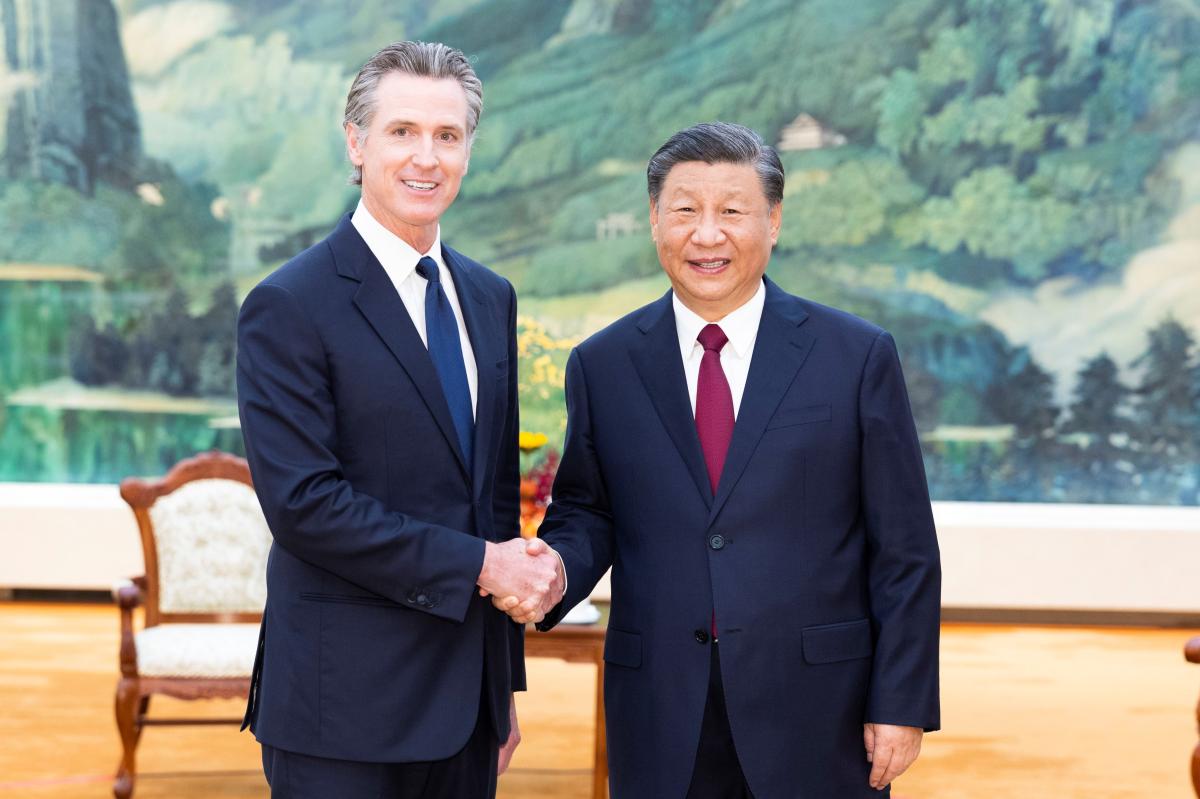
Will China Favor Gavin Newsom in 2028?
Amid ongoing discussions about U.S. political alignments, an intriguing narrative emerges: the potential favoritism of China’s President Xi Jinping towards California Governor Gavin Newsom. While President Trump has often been depicted as a proxy for Russia by progressives, a far-reaching question arises: Who does Xi Jinping prefer in the White House come 2028?
China’s Financial Power vs. Russia’s Influence
Unlike Vladimir Putin’s Russia, which remains economically irrelevant on a global scale, Xi Jinping’s China boasts significant financial prowess, deep connections to business elites, and advanced technical capabilities. This gives Xi a strategic edge in advancing his political agenda, especially as the U.S. gears up for the 2028 elections.
Recent reports from major outlets including the Asia Times and Bloomberg suggest that Beijing views Newsom as a formidable candidate to succeed President Biden, particularly after Biden’s lackluster debate performances. In China, Newsom is perceived as a fresh and pragmatic leader, contrasting sharply with the current administration.
A Favorable Relationship
The relationship between California and China is often characterized as resembling a colonial tie. Currently, China imports approximately $15 billion in goods from California, while exporting a staggering $122 billion back to the state. This trade imbalance highlights California’s primary strengths in agricultural exports and services, especially technology, which still pales in comparison to the merchandise deficit.
The stark disparity has elicited concerns that this pattern may jeopardize jobs in California, a sentiment resonating with some Democrats and MAGA Republicans alike. However, Newsom appears to be more aligned with his affluent supporters in Silicon Valley than the labor force.
Silicon Valley’s Interests
Newsom’s political approach seems heavily influenced by the tech giants of Silicon Valley, like Apple, whose CEO, Tim Cook, advocates for close ties with China. With venture capital firms hiring offspring of Chinese political elites, the intertwining of California’s tech industry with Chinese interests appears deeper than ever.
Despite concerns regarding China’s long-term threat to American interests, Newsom continues to navigate these waters skillfully, seeking to cater to the wealthy donor class while ignoring the struggles of ordinary workers.
Dealing with Xi
Newsom’s interactions with Xi Jinping, as highlighted at various events including Xi’s 2023 appearance in San Francisco, reflect a willingness to prioritize relationship-building with China over local welfare. For instance, he faced criticism for attempting to clean up San Francisco in time for Xi’s visit, a move that underscored his commitment to catering to the Chinese leader.
Interestingly, California progressives seem conflicted. Advocating for human rights on one front, they simultaneously engage cooperatively with one of the world’s most authoritarian regimes. As every aspect of governance aligns with China’s ambitions, this complicity has raised eyebrows among critics.
Environmental and Economic Ramifications
Newsom’s pro-China stance extends to environmental policies as well. By emphasizing a renewables-only energy agenda, he inadvertently places California at the mercy of China’s manufacturing prowess in technology and materials needed for electric infrastructures.
Historical patterns show that California’s political elite, since the tenure of Governor Jerry Brown, have benefited financially from Chinese investments. This includes significant funding for educational institutions from organizations linked to the Chinese Communist Party.
Political Alliances and Implications
Newsom is not alone in aligning with China. Former officials like Senator Dianne Feinstein and Congressman Eric Swalwell have all faced scrutiny for their ties to Chinese operatives, illustrating a broader pattern of Beijing leveraging influential figures in the U.S. political landscape.
As California hosts around 40% of the U.S. Chinese community—many of whom fled communism—Newsom’s administration has shown a curious willingness to engage with Chinese governmental bodies, such as the China International Friendship Conference, despite the evident risks.
A Strategic Long-Term Game
China’s strategic approach to political influence is far more subtle than Russia’s. Beijing has fostered engagement with progressive factions in the U.S., aligning financial support with political agendas—such as recent protests in Minneapolis—potentially aiming to destabilize national interests that could oppose their global ambitions.
For Xi and his regime, who occupies the White House is pivotal. An unpredictable figure like Trump may pose challenges to Chinese aspirations, whereas a return to progressive governance could bolster their ascent unencumbered.
As the political landscape evolves, the prospect of a Newsom administration raises essential questions about America’s relationship with China and the influence it could wield over U.S. policy for decades to come.
This article illustrates a complex interplay of political power, economic interests, and international relations. The future impact of these dynamics will significantly shape both California and the broader United States in the years ahead.
