

California Gubernatorial Race: A Wide-Open Contest Amid National Distractions
California, home to nearly 40 million residents and boasting the fourth largest economy in the world, faces a unique political landscape as it heads into the gubernatorial race. With less than five months until the June primary election, the contest has become overshadowed by national events, particularly President Trump’s anticipated return to office. In a significant shift, there is currently no clear front-runner among the numerous candidates vying for the position.
A Unique Political Climate
“This is the most wide-open governor’s race we’ve seen in California in more than a quarter of a century,” asserts Dan Schnur, a political communications professor at USC, Pepperdine, and UC Berkeley. Historically, gubernatorial races have featured dominant candidates, but this election showcases a crowded field with minimal clarity. Polls reveal increasing numbers of undecided voters, with many not rallying behind any of the dozen or so prominent candidates in the running.
Recent Polling Insights
The Public Policy Institute of California recently conducted a survey revealing that former Rep. Katie Porter (D-Irvine) leads the pack with 21% support among likely voters. Meanwhile, former U.S. Health and Human Services Secretary Xavier Becerra and Republican commentator Steve Hilton each garnered 14% of the vote. Chad Bianco, the Riverside County Sheriff, commands 10%, while the remaining candidates struggle to reach double digits even with notable Democratic contenders still joining the fray.
The Shadow of Charismatic Leadership
Past gubernatorial campaigns in California have been characterized by larger-than-life personalities such as Arnold Schwarzenegger and Jerry Brown. Gov. Gavin Newsom, who has emerged as a significant figure in national Democratic politics, won his previous races convincingly yet is unable to run again due to term limits.
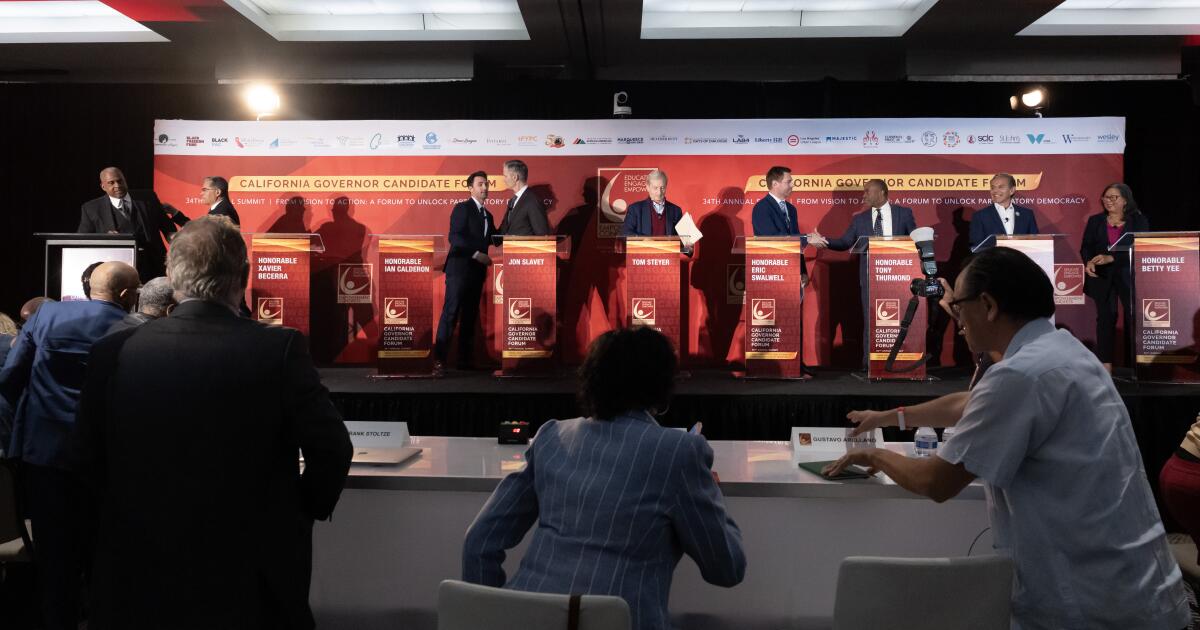
At a recent labor forum, Porter quipped about the historical lack of diverse leadership in California: “Look, we’ve had celebrity governors… We haven’t had a governor in a skirt. I think it’s just about time.” This statement underscores the shifting dynamics and expectations in a state where identity and representation are increasingly pivotal.
Challenges in Gubernatorial Contests
The scrutiny surrounding California’s 2026 election has been notably minimal, especially given the state’s association with landmark issues during the Trump administration, such as immigration policy. Factors like wildfires, immigration enforcement, and intricate congressional district redrawings have diverted public attention from the upcoming race.
The potential entries of major political figures like former Vice President Kamala Harris and Sen. Alex Padilla (D-Calif.) delayed the field, leading to uncertainty as none opted to compete for the governor’s seat. Fresh candidates like San José Mayor Matt Mahan, who recently announced his candidacy, further reflect the evolving nature of the race.
A Focus on Key Issues
Mahan emphasized the need for transformative leadership to tackle pressing issues, stating, “I have not heard anyone in the current field explain how they’re going to help us… end unsheltered homelessness.” Issues such as this are becoming increasingly crucial in shaping the narrative around the governor’s race.
The Financial Landscape
As the primary election approaches, financial backing plays a critical role in determining candidate viability. Fundraising reports due on February 2 will provide clarity on who’s raising significant resources in a state with the nation’s priciest media markets.
Veteran political strategist Garry South remarked, “There comes a day when a candidacy is no longer sustainable because of a lack of resources.” Candidates must secure adequate funding to effectively communicate with California’s 23 million registered voters.
Party Dynamics and Candidate Viability
The state Democratic and Republican conventions loom large, with expectations that some Democratic candidates with insufficient financial resources may be encouraged to withdraw to consolidate support for a more viable contender.
However, differing perspectives exist. Democratic strategist Hilda Delgado points to the current atmosphere as lacking excitement, stating, “Right now is really about the core issues that will unify Californians.” Delgado suggests that voters seek inspiring leadership that addresses their concerns.
Looking Ahead
As the June primary draws nearer, the California gubernatorial race remains a focal point of political intrigue, poised between dynamic local issues and the extensive backdrop of national politics. With no clear frontrunner and vital questions surrounding candidate viability and public engagement, the upcoming months will be critical in shaping the landscape of California’s political future.
For the latest updates on the California gubernatorial race and candidate profiles, visit Los Angeles Times or review findings from the Public Policy Institute of California.
