

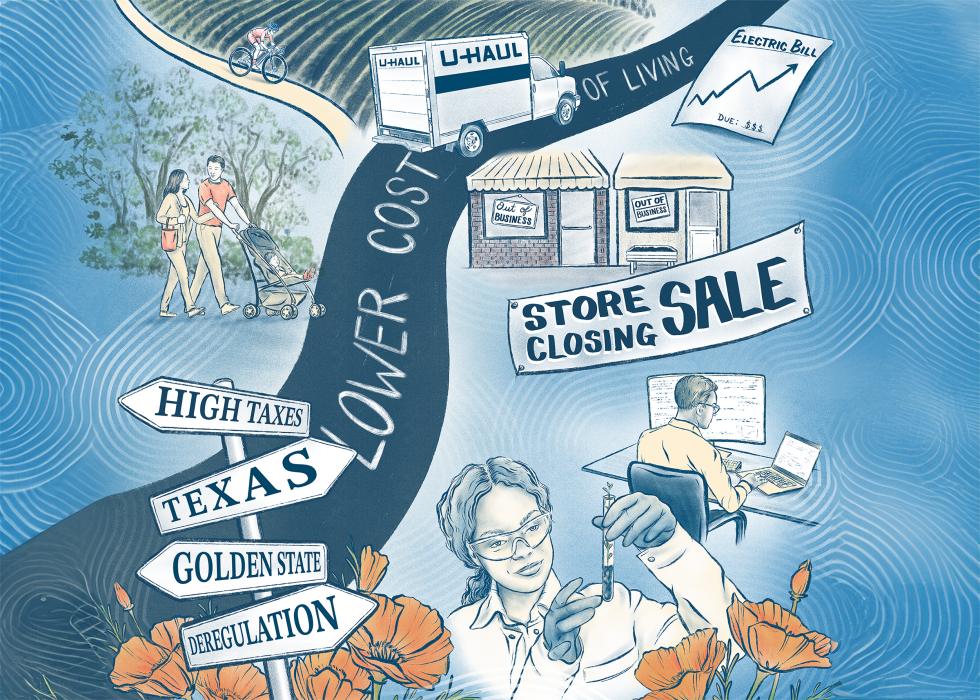
The Dual Narrative of California’s Corporate Landscape: Exodus and Opportunity
California has long been a focal point for business innovation and entrepreneurship, yet a significant narrative of corporate migration has emerged in recent years. Many companies are leaving the Golden State in search of better economic conditions, while others are finding success and sustainability within its borders. This article explores the reasons behind this trend, highlighting key figures and case studies to paint a comprehensive picture of California’s complex business environment.
The Exodus: Corporations Leaving California
Take Waste Connections, for instance. Led by President and CEO Ronald Mittelstaedt, the company relocated its headquarters from Sacramento to Texas in 2012. The decision stemmed from the pursuit of a happier workforce, given Texas’s lower cost of living—about 15% more affordable than California. Texas also offers no state income tax, allowing employees to retain more of their earnings. Since the move, Waste Connections has experienced tremendous growth, skyrocketing its revenue from $1.5 billion to over $10 billion and expanding its workforce from 6,000 to 26,000 employees. “The talent we needed wouldn’t have come to Sacramento,” Mittelstaedt asserts.
Numerical data corroborate the corporate exodus. According to a 2022 report from the Hoover Institution, California lost 352 company headquarters between January 2018 and December 2021, with a noted acceleration in departures in 2021. Factors contributing to this trend include high taxes, stringent regulations, and exorbitant living costs, particularly housing. As highlighted in the Fraser Institute’s economic freedom index, California ranks a dismal 47th among U.S. states.
Moreover, manufacturing jobs have also dwindled, with about 83,000 jobs lost since September 2022. Industry representatives cite high equipment costs and burdensome state regulations as principal culprits.
The Persistence: Companies Thriving in California
While some firms leave, others are finding opportunities in the state. Pam Marrone, a biotech entrepreneur, exemplifies this resilience. After starting Marrone Bio Innovations in 2006, Marrone sold the company in 2022. The new leadership contemplated moving it to cost-effective Research Triangle Park in North Carolina, but ultimately opted to return to Davis, California. The decision came down to employee preference and the region’s proximity to their target market: local farmers.
In 2023, Marrone launched Invasive Species Corporation in Davis, focusing on organic pest control. The area’s agricultural ecosystem and community amenities, such as biking and public transportation, make it a desirable location, especially for talent emanating from nearby UC Davis.
Marrone believes that for agtech firms, California is uniquely positioned. “This region is a gem that doesn’t get the publicity that St. Louis and Research Triangle Park get in terms of agtech startups,” she remarks.
Factors Influencing Corporate Decisions
Though media discussions often center around the exodus of corporations, it’s essential to recognize that many firms leave for multiple reasons. For example, the Educational Media Foundation moved to Nashville to tap into the local music community, citing a need for deeper engagement rather than negative business conditions in California.
Anheuser-Busch’s closure of its Fairfield brewery in 2023 serves as another case; the company aimed to streamline operations across its facilities rather than cite California’s regulatory environment as a reason for the closure.
A Balance of Migration and Growth
Despite the high-profile departures, the state continues to see growth in new startups. A 2021 report found that approximately 800 new companies opened in California, even as 200 moved out of state. In fact, the net gain of businesses within the state has remained positive, with around 245,000 new companies established from March 2023 to March 2024.
The Greater Sacramento Economic Council noted that foreign-owned businesses are also making their way into the region, creating thousands of new jobs. The data suggests that while the headlines focus on the exit of major corporations, California is still firmly grounded as a hub for startup innovation and foreign business acquisition.
Conclusion: The Allure of California
As California’s corporate landscape continues to evolve, the dual narrative of exodus and opportunity highlights a complex economic environment. While challenges such as high taxes and regulations exist, the state’s natural beauty, talent pool, and entrepreneurial spirit remain undeniable draws. As Mittelstaedt summarizes, “All the things that the state government doesn’t have anything to do with are great in California.”
California’s allure may continue to attract businesses and talent amid ongoing challenges, ensuring that its storied legacy as a place of innovation persists.
Sources for Further Reading:
